
The Mythos Effect: Why Exposure Intelligence Matters More Than Ever
Why Mythos (and other AI models) Make Continuous Exposure Visibility Critical
For years, vulnerability discovery was naturally constrained by expertise, time, and scale. Finding meaningful security issues often required experienced researchers spending days or weeks understanding codebases, testing assumptions, reviewing implementations, and validating exploitability.
That dynamic is changing rapidly.
Recent developments around systems like Anthropic’s Project Glasswing 🔗 and Mythos, OpenAI’s Daybreak initiative 🔗, and public examples of AI-assisted security research have shown that modern AI models can meaningfully accelerate parts of the vulnerability research process. Mozilla recently discussed 🔗 how AI-assisted workflows helped improve Firefox hardening efforts and accelerate vulnerability identification across large legacy codebases. Similarly, public discussions around AI-assisted vulnerability discovery in projects like curl demonstrate that these capabilities are moving beyond theory into practical workflows.
The important takeaway is not that AI replaces security researchers. Rather, AI significantly improves the speed, scalability, and accessibility of existing research workflows.
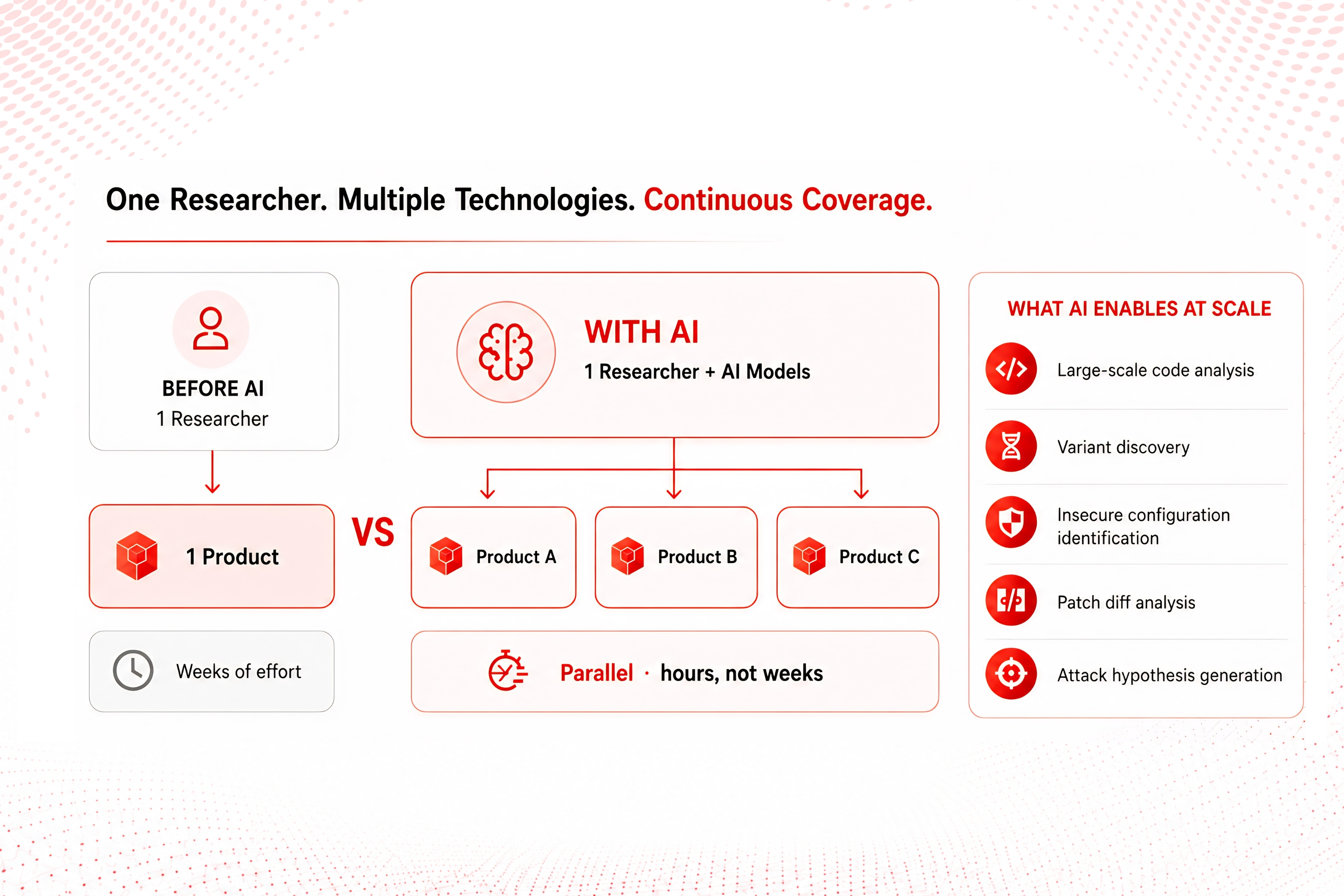
Tasks such as large-scale code analysis, variant discovery, insecure configuration identification, patch diff analysis, and attack hypothesis generation can now increasingly be performed faster and at greater scale than before. This changes the economics of vulnerability discovery.
AI Is Accelerating Discovery, Not Inventing It
The security industry has always relied heavily on automation. Fuzzing, source code scanning, static analysis, symbolic execution, and custom tooling have existed for years and continue to remain important.
What AI changes is the ability to combine reasoning, context understanding, and automation into workflows that can operate continuously across large amounts of code, technologies, and exposed assets.
A researcher who previously needed substantial manual effort to analyze one product can now investigate multiple technologies in parallel using AI-assisted workflows. This is especially relevant because modern enterprise environments are already highly fragmented and continuously evolving. Organizations today operate across cloud platforms, SaaS applications, APIs, open-source dependencies, developer tooling, and increasingly AI-driven infrastructure.
As the technology footprint expands, so does the attack surface. AI simply makes it easier and faster to identify weaknesses within that growing ecosystem.
Mozilla’s recent disclosures provide a practical example of this shift. The organization stated 🔗 that AI-assisted workflows contributed to fixing 423 Firefox security bugs in a single month, with 271 linked specifically to Claude Mythos Preview-assisted workflows. Mozilla also noted that some vulnerabilities identified through these workflows had remained undiscovered for years despite traditional testing approaches.
We Are Already Seeing This Shift Practically
At RedHunt Labs, we have already observed this trend firsthand.
Using publicly available AI models combined with custom security harnesses and workflows, we identified multiple previously unknown vulnerabilities in technologies actively used by enterprises, including AI-focused platforms such as n8n and Flowise. Some findings turned out to be duplicate reports of issues that were already privately known but still undisclosed or unfixed at the time of reporting.


Some were accepted and fixed. One such example can be found here 🔗:
A few CVEs currently remain under coordinated disclosure and are in the Reserved state, including issues affecting technologies with millions of active deployments.

Importantly, this work was performed using publicly accessible models rather than restricted frontier systems. This is a critical point as advanced AI-assisted vulnerability discovery capabilities are gradually becoming accessible to a much broader ecosystem of researchers, defenders, and, unfortunately, attackers as well.
The Industry Is Moving Toward Vulnerability Abundance
Historically, discovering vulnerabilities at scale was difficult and expensive. That naturally limited the overall rate of high-quality findings entering the ecosystem.
AI changes that balance significantly.
As vulnerability discovery becomes faster and more scalable, the industry is likely to see increasing CVE volumes, more variant discoveries, faster identification of exposed components, and greater scrutiny of internet-facing systems and third-party infrastructure.
We are already seeing signs of this operational pressure. Verizon’s 2025 DBIR 🔗 reported that vulnerability exploitation grew to account for 20% of breach initial access vectors, representing a 34% increase year over year. The report also highlighted increased exploitation targeting edge devices and externally exposed systems.
At the same time, CISA’s Known Exploited Vulnerabilities (KEV) catalog 🔗 continues to expand rapidly as more vulnerabilities are actively weaponized in the wild.
This does not necessarily mean every organization suddenly becomes insecure overnight. Many vulnerabilities still require specific conditions, exploit chaining, or particular deployment scenarios.
However, it does mean organizations should expect faster discovery cycles, shorter timelines between discovery and exploitation, and increasing visibility into exposed weaknesses across the internet.
Visibility Matters More Than Vulnerability Counts
One of the most important implications of AI-driven vulnerability discovery is that simply tracking vulnerabilities is no longer enough.
Most enterprises already struggle with remediation prioritization because modern environments are dynamic. Assets change continuously. New cloud instances appear. SaaS platforms get onboarded without centralized visibility. Development environments become externally reachable. Forgotten services remain exposed for long periods.
In this environment, the real challenge is no longer just identifying vulnerabilities. It is understanding what assets exist, what technologies are exposed, which services are internet reachable, and where exploitable exposure actually exists.
This is where continuous asset discovery and attack surface visibility become operationally critical.

Organizations increasingly require the ability to continuously discover and monitor externally exposed assets, technologies, and frameworks in use, cloud services and SaaS dependencies, exposed administrative interfaces, APIs, and developer environments, and shadow IT infrastructure.
Without this visibility, organizations may not even know where vulnerable technologies exist within their environment.
Exposure Context Is Becoming More Important Than CVSS Alone
As vulnerability discovery scales, raw vulnerability counts become less meaningful on their own.
A low-severity issue on an isolated internal system may carry limited operational risk. On the other hand, a remotely exploitable vulnerability on an exposed internet-facing application or third-party service may require immediate attention.
This is why exposure context becomes increasingly important.
Organizations need the ability to understand whether vulnerable assets are externally reachable, whether exploit paths are realistic, whether sensitive systems are accessible, whether exposed technologies are actively used, and whether third-party providers introduce additional exposure.
The future of enterprise security is likely to focus far more on contextual exposure understanding rather than simply accumulating vulnerability data.
The Third-Party Risk Problem Is Growing
Modern organizations rely heavily on external vendors, SaaS platforms, APIs, cloud providers, and supply chain integrations. In many environments, third-party systems now process sensitive business operations, authentication workflows, customer data, and operational infrastructure.
At the same time, attackers increasingly target vendors and supply chain dependencies because they often provide broader access paths into enterprise environments.
As AI-assisted discovery capabilities improve, externally exposed third-party infrastructure will likely receive far more scrutiny. Weak integrations, vulnerable dependencies, exposed administrative portals, and forgotten internet-facing systems become easier to identify at scale.
This creates an important shift for third-party risk management programs.
Historically, TPRM often focused heavily on questionnaires, periodic reviews, and compliance assessments. Those processes still matter, but they are no longer sufficient on their own.
Organizations increasingly require continuous visibility into the external exposure posture of vendors, subsidiaries, acquired entities, SaaS providers, and strategic partners. In many cases, exposure introduced through third parties may become more operationally relevant than internally managed vulnerabilities.
The Shift Toward Continuous Exposure Reduction
As AI accelerates vulnerability research, the most effective security programs will likely be the ones that can continuously discover assets, monitor exposure, identify technologies in use, detect vulnerable components, understand third-party exposure, and reduce externally reachable attack surface.
This is where Attack Surface Management and Continuous Threat Exposure Management (CTEM) becomes critical.
The focus shifts away from periodic visibility and toward continuous monitoring and exposure reduction. Organizations need the ability to continuously map their internet-facing footprint, detect technology changes, identify exposed services, correlate technologies with emerging vulnerabilities, and prioritize risks based on real-world reachability and exposure.
In many situations, reducing exposure itself may become more important than immediate patching.

Final Thoughts
AI-driven vulnerability discovery is no longer theoretical research confined to a handful of advanced labs. The combination of increasingly capable models, automated reasoning, and custom security harnesses is fundamentally changing the speed and scale at which vulnerabilities can be discovered across the internet.
The larger impact, however, is not simply that more vulnerabilities may be identified. The more important shift is that organizations now require far better visibility into their own exposure landscape and the exposure introduced through third parties.
As discovery becomes faster and more scalable, security programs will increasingly depend on continuous asset discovery, technology intelligence, exposure monitoring, and contextual risk understanding.
The organizations that adapt best will likely not be the ones with the fewest vulnerabilities. They will be the ones with the strongest understanding of their attack surface, their technology landscape, their third-party exposure, and their ability to continuously reduce reachable risk.
References
· Anthropic Project Glasswing 🔗
· Mozilla on AI-assisted Firefox hardening 🔗
· The Zero-Days Are Numbered – Mozilla Blog 🔗
· Mythos finding a curl vulnerability 🔗